Part five of a series examining the real forces behind Iowa’s data center debate.
A Post That Wasn’t What It Seemed
On June 1 at 5:53 in the morning, an image appeared in the Facebook feeds of tens of thousands of Iowans. A breathtaking aerial photograph of Iowa farmland glowing at sunset, the outline of the state drawn in white across rolling fields and a winding river. Bold text read: “Not a single square inch of Iowa is worth giving up for an AI Data Center.”
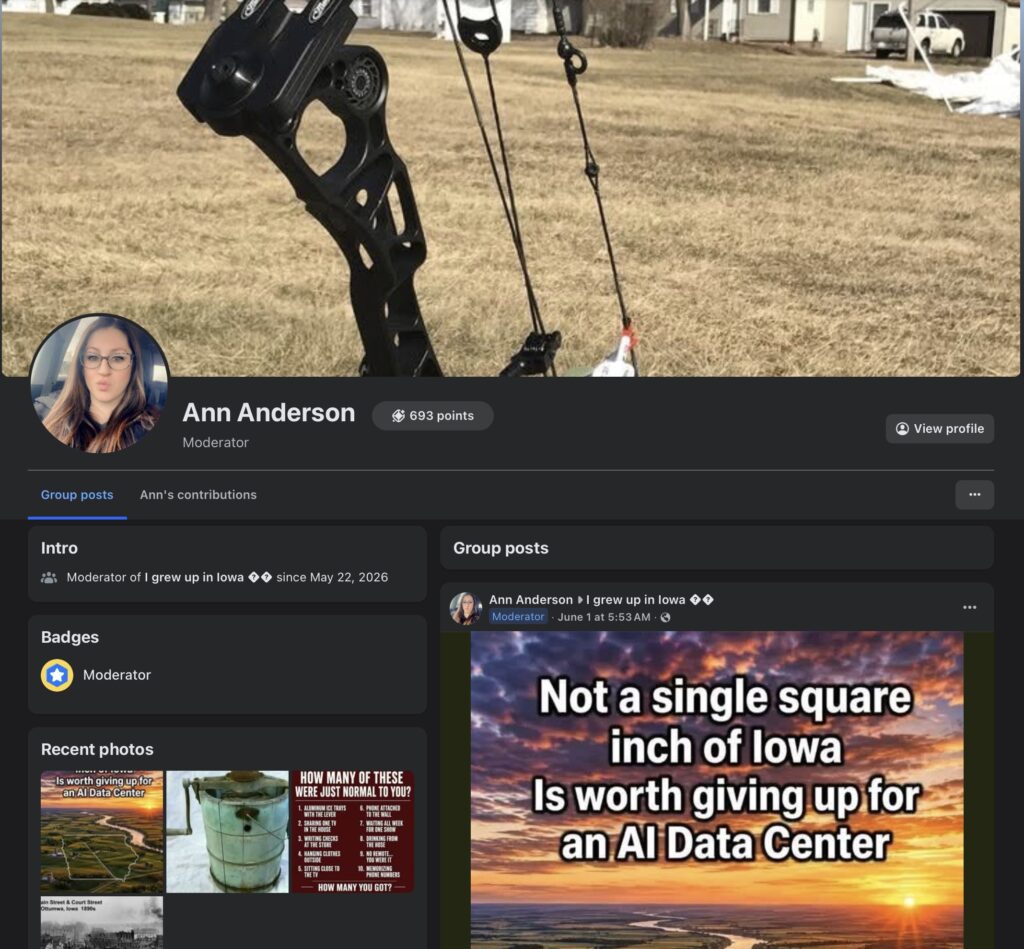
It carried no source, no context, no facts — just an image engineered to make any compromise feel like a betrayal of Iowa’s heritage. It was posted by a group moderator named Ann Anderson to a Facebook group called “I grew up in Iowa”, one of at least seven nearly identical groups collectively reaching more than 300,000 Iowans.
Three minutes earlier, at 5:50 AM, Ann had posted something warmer: “my brother swears this was never a thing! does anyone else remember having to geta blood test just to get a marriage license?” Real Iowans flooded the comments with memories. The emotional groundwork laid, the propaganda followed.
What those Iowans almost certainly did not know: Ann Anderson is not who she appears to be. And the people actually operating these groups are not from Iowa — or anywhere near it.
Meet the Real Moderators
A review of Ann Anderson’s Facebook friends list tells the story plainly. Among the 146 accounts she follows:
- মোস্তাফিজুর রহমান — Rangpur, Dhaka, Bangladesh (name written in Bengali script)
- Muhammad Sujon — Manik nagar model high school, Bangladesh
- হকের আহ্বান — Chittagong, Bangladesh
- MD Ujjol Ahmod — nabiganj degree college, Bangladesh
- Ranjit Soren — Balurghat, West Bengal, India
- Kholil Khan — Manama, Bahrain
- Md Azad Ahmed — “Works at I’m proud to be a Muslim”
- Mohammed Sheikh Shuhag Shuhag — Generator Engineer
- Aniket Kumar
- Jahed Miah
- Only In Iowa — Des Moines, Iowa
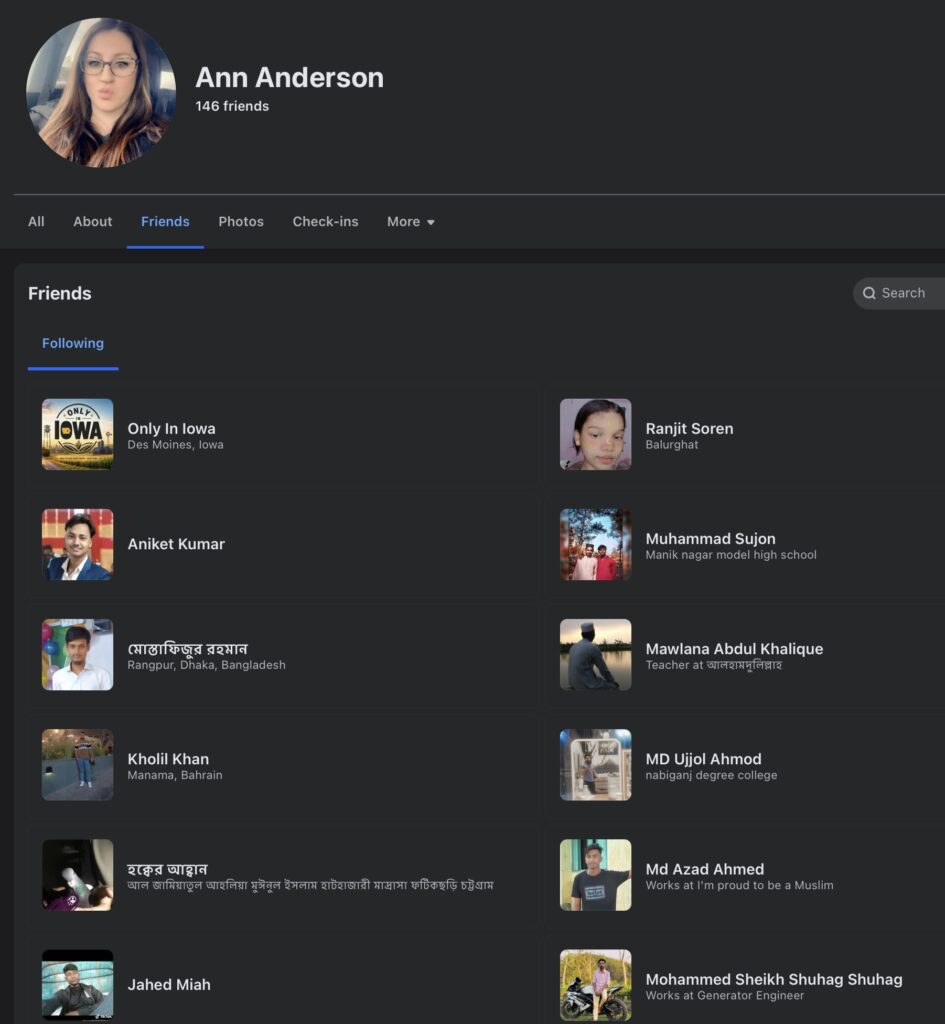
One Iowa connection. Ten from Bangladesh, India, and Bahrain — many with names displayed in Bengali script. Ann Anderson, who was made moderator of the “I grew up in Iowa” group on May 22, 2026 — just ten days before posting anti-data-center propaganda — posts at 5:50 in the morning Iowa time. That is late afternoon in Dhaka.
The nostalgia bait post even contains a telltale error: “having to geta blood test” — a non-native English contraction that no lifelong Iowan would write.
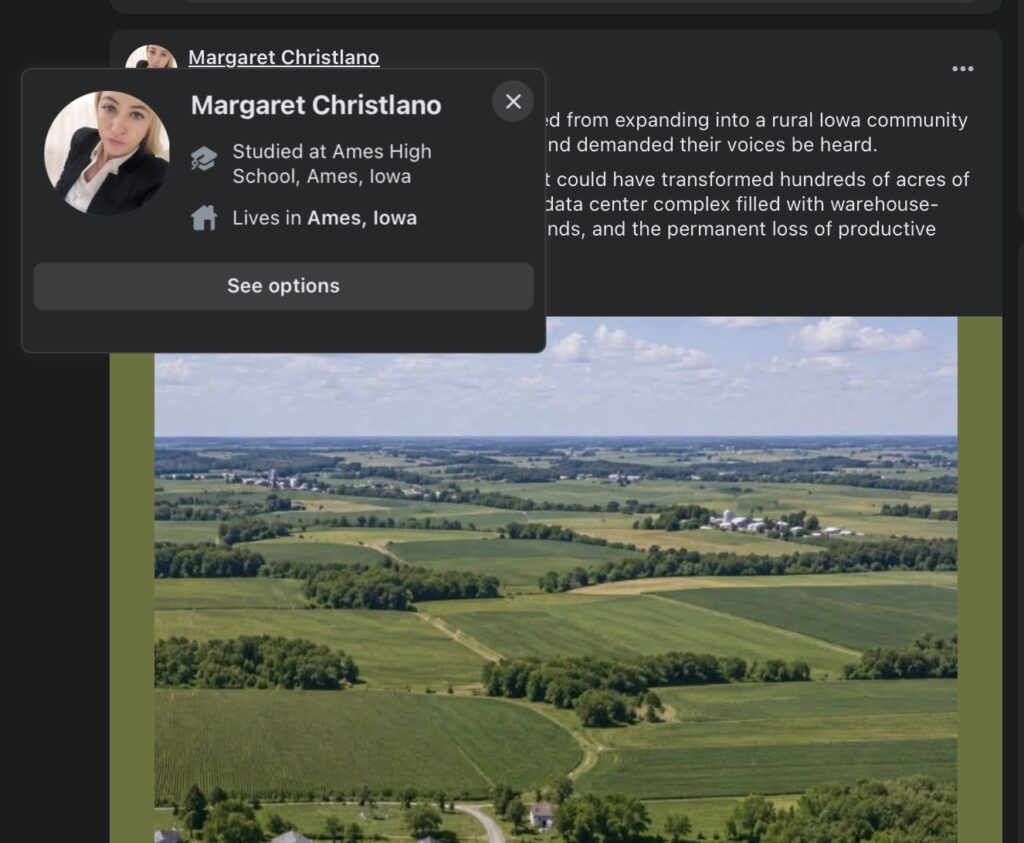
A second account posting similar content to these groups, “Margaret Christlano,” lists “Ames High School” under the “College” section of her Facebook profile. No Iowa resident would make that mistake — Ames High School is a high school, not a college. The surname “Christlano” does not appear in any Iowa records. Her photos are a mismatched collection of generic landscapes, a harbor scene bearing no resemblance to Iowa, and memes.
The Architecture of the Network
These individual fake moderators are just the human face of a much larger machine. The administrator lists of the Iowa Facebook groups reveal that the real controllers are not people at all — they are pages: “Images of Iowa,” “State Stories,” “State of Iowa,” “Life in Iowa,” and “I grew up in Iowa,” all listed as group administrators, each one adminning the others in a circular loop. No individual human being is ultimately accountable.
This structure – pages adminning pages – is a documented tactic for evading Facebook’s automated systems for detecting coordinated inauthentic behavior. It creates the appearance of independent community groups while functioning as a single coordinated operation.
The network’s growth engine is equally calculated. The master page “I grew up in Iowa” creates subsidiary groups like “Life in Iowa.” Facebook’s own “Related Groups” algorithm then promotes these sister groups to anyone who joins one, pulling Iowa users deeper into the ecosystem without any additional effort from the operators. The banner of “Life in Iowa” declares: “Real People. Real Life. Real Iowa.” None of those words are accurate.
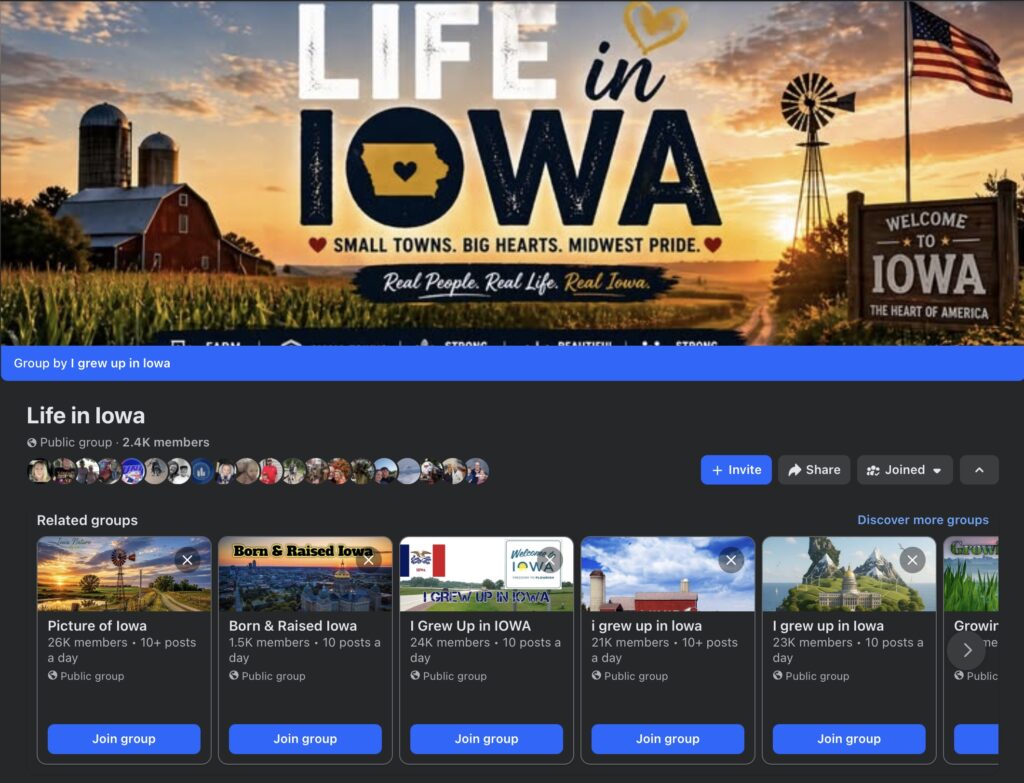
The nostalgia content — endless questions about favorite drive-ins, old Iowa towns, childhood memories — is not incidental. It is the mechanism. High-engagement posts generate enormous comment activity, which trains Facebook’s algorithm to push that group’s content to the top of members’ feeds. Trust accumulates over months of shared warmth. Then the propaganda arrives in the same trusted feed.
This Is Not Just Iowa
The same network is running the identical playbook across state lines. “Life in Nebraska” — one of the pages listed as an administrator of the Iowa groups — posted this message on June 2: “You can’t drink data. Nebraska knows that clean, reliable water is essential for families, farms, and future generations.” Accompanying it: an AI-generated image of a water tower painted with the words “YOU CAN’T DRINK DATA — NEBRASKA —” positioned against what appears to be the Nebraska State Capitol.
Same template. Same messaging strategy. Same AI-generated imagery. Different state outline.
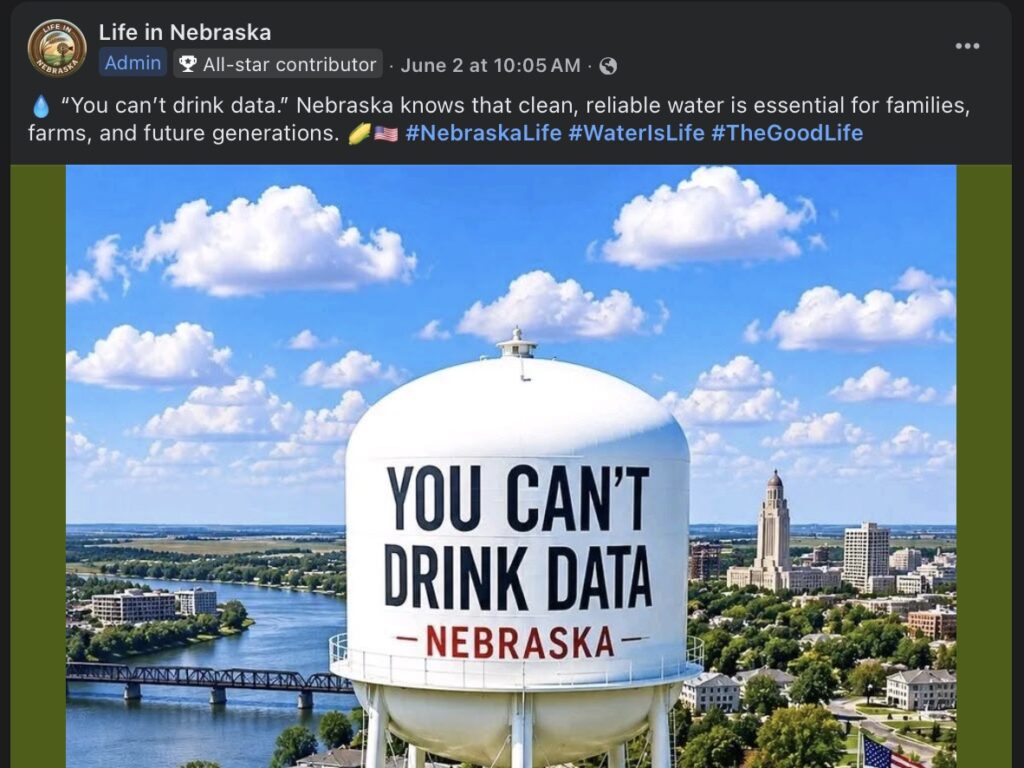
The operators of this network did not build it for Iowa. They built it for the entire Midwest – and likely beyond – targeting every state where data center development is generating public debate. Iowa is one node in a multi-state influence operation running simultaneously across the region.
The Reach Is Staggering
The combined membership of the confirmed “I grew up in Iowa” variant groups alone exceeds 300,000. Individual groups post at rates of 20 to 40 times per day. Because members share posts, the actual reach of any single viral image is far larger than the membership numbers suggest.
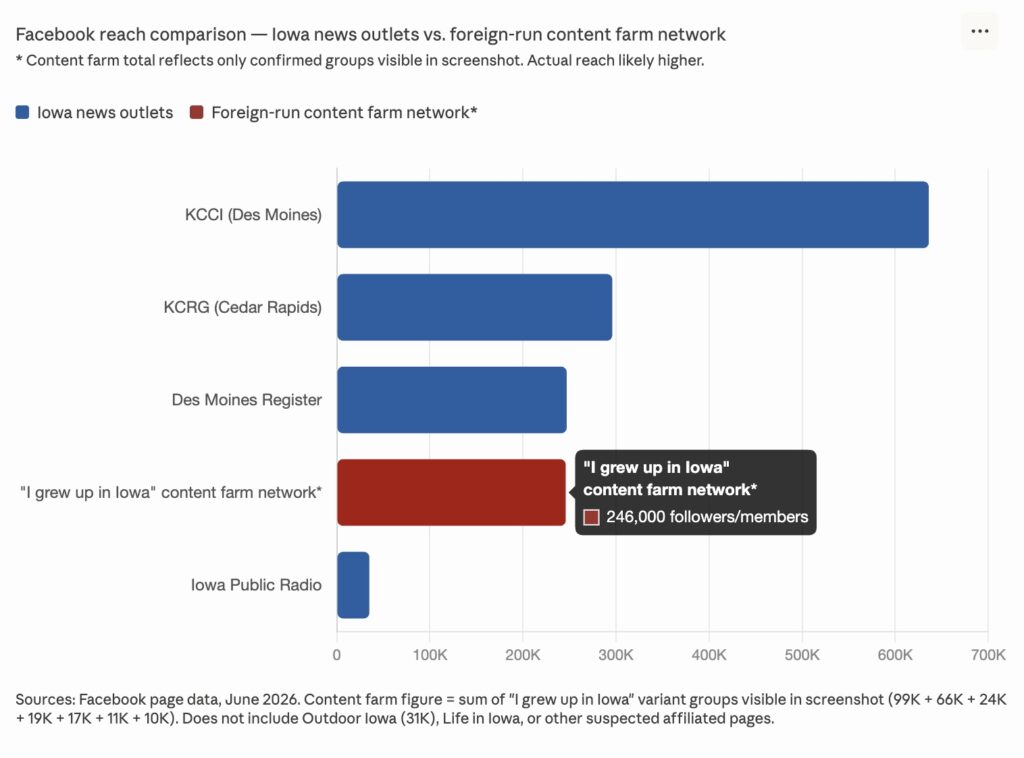
For context: the Des Moines Register’s Facebook page has approximately 247,000 followers. KCRG, the Cedar Rapids television station that has extensively covered the data center debate, has roughly 296,000. Iowa Public Radio has an estimated 35,000 Facebook followers.
A foreign-run content farm network — operated at least in part from Bangladesh — has assembled a Facebook audience comparable to the state’s largest newspaper, and is using it to shape how Iowans think about one of the most consequential economic decisions their communities will face in a generation. Iowa’s professional news organizations, for all their resources, have not reported a word about it.
The Money Behind the Messaging
The Facebook content farms appear to operate for profit – building large audiences through high-engagement content and monetizing them through advertising. The anti-data-center messaging they occasionally inject may be content they have been paid to distribute, or simply posts they have found generate strong engagement and sharing. Either way, they do not exist in isolation from a much larger and more expensively funded campaign.
According to a report published in April 2026 by the American Energy Institute, 12 organizations actively opposing U.S. data center development have collectively received more than $39 million from foreign donors. The foreign funders include:
- Chris Hohn, a British hedge fund billionaire whose philanthropic vehicles gave at least $3.75 million to organizations that signed a December 2025 congressional letter demanding a national moratorium on data center construction — including $1.2 million to Food & Water Watch alone. The irony: Hohn’s hedge fund simultaneously holds nearly $1 billion in Alphabet stock, Google’s parent company, even as his foundations fund campaigns to stop Google’s data centers from being built.
- Quadrature Climate Foundation, a UK-based philanthropic organization identified as a foreign funder of anti-data center advocacy.
- Hansjörg Wyss, a Swiss billionaire whose Wyss Foundation and Berger Action Fund have channeled significant money into U.S. environmental advocacy infrastructure.
- The KR Foundation, based in Denmark.
A separate report from the Bitcoin Policy Institute documented three vectors of foreign influence targeting U.S. AI infrastructure: coordinated messaging campaigns from Chinese state media including CGTN, China Daily, and Global Times; a network of U.S. nonprofits funded by Neville Roy Singham, a Shanghai-based tech entrepreneur with documented ties to Chinese Communist Party media organs; and the foreign billionaire charitable network described above. The report noted that 54 local data center moratoriums have been passed nationwide, with nine more under consideration.
Whether the Bangladeshi content farm network has any direct connection to these well-funded advocacy organizations is not established. What is established is that they are all pushing the same message – and that the message is reaching Iowans through channels those Iowans believe are their own neighbors speaking.
Three Reasons This Is Not an Algorithm – It Is an Attack
Some have suggested that what these groups are doing is simply good content farming — posting whatever topic is generating buzz in order to drive engagement and advertising revenue. It is a reasonable hypothesis. It is also wrong, and three specific observations prove it.
First: these groups were created recently. Long-established Iowa nostalgia communities that built their audiences over years by posting genuine local content do not suddenly pivot to political messaging about data centers. Multiple groups in this network appear to have been created or significantly expanded in 2025 and 2026 — precisely as the Iowa data center debate intensified. They were not communities that found a topic. They were operations built for a purpose.
Second: they post about data centers and nothing else politically. A genuine Iowa content farm chasing engagement would post about whatever generates reactions — gas prices, the Iowa Hawkeyes, farm policy, local crime, the weather. These groups post one and only one political message: opposition to AI data centers. Scroll through their recent posts. Count the political topics. There is one. That singular focus is not the behavior of opportunistic algorithm-chasers. It is the behavior of a targeted influence campaign.
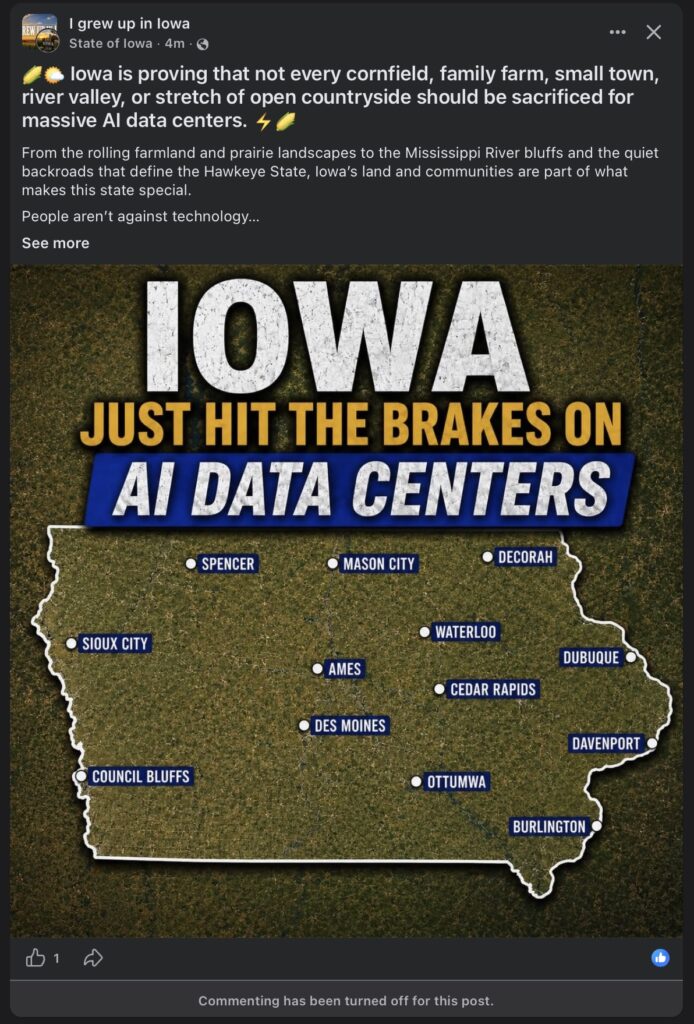
Third — and most telling — they are turning off comments. On June 7, a post appeared on “I grew up in Iowa” declaring “IOWA JUST HIT THE BRAKES ON AI DATA CENTERS” — a claim that is flatly false; Iowa has passed no such measure. Below the post appeared a notice that no content farm operator ever wants to see on their own post: “Commenting has been turned off for this post.”
This is the smoking gun. Facebook’s algorithm rewards comments above nearly all other engagement signals. Comments drive reach. Comments drive the algorithm to show a post to more people. Comments are how content farms make money. Any group genuinely trying to maximize engagement would never, under any circumstances, turn off comments — it is financial self-sabotage.
The only reason to disable comments on a political post is to prevent fact-checkers, skeptics, and people who recognize disinformation from leaving rebuttals in the thread. The operators do not want a debate. They want a one-way broadcast of a false claim — delivered to hundreds of thousands of Iowans — with no mechanism for correction or reply.
That is not content farming. That is a coordinated political influence operation, and it is happening right now in Iowa Facebook groups that your neighbors think are run by people like them.
The Stakes Are Immediate
The Palo City Council is scheduled to vote on a Google data center zoning ordinance on June 15 and June 22. Approximately 150 residents packed a public hearing on June 2 to oppose the project, many expressing alarm about water and Iowa’s future. It is a fair question — and an unanswerable one — how much of that alarm was shaped by content produced in Dhaka and filtered through a Facebook group called “I grew up in Iowa.”
The concerns residents have raised about water, noise, and community character deserve serious engagement — and this series has attempted to provide it honestly. But serious engagement requires accurate information. When the information environment is being shaped by fake moderators, AI-generated imagery, circular page networks, and overseas operators whose Facebook friends live in Bangladesh and Bahrain, the quality of the public debate suffers. And so do the communities trying to make good decisions within it.
What You Can Do Right Now
Before sharing any post from an Iowa Facebook group, spend 30 seconds clicking on the group’s “About” section and viewing its administrator list. If the administrators are pages rather than people, or if clicking through reveals profiles with overseas connections, treat the content with the same skepticism you would apply to any anonymous flyer slipped under your door.
You can also report suspected fake accounts and coordinated inauthentic behavior directly to Facebook.
The Palo City Council votes June 15 and June 22. Whatever position you hold on that question, you deserve to reach it based on facts – not on a meme generated by artificial intelligence and posted at 5:53 in the morning by someone whose Facebook friends live in Dhaka.
I have new articles going up every week on my web site that deal with the facts, not the hysteria. They will help you understand the issues around AI and data centers.
Iowa’s AI Future is a newsletter and website covering artificial intelligence’s impact on Iowa business, agriculture, and education. Subscribe at IowasAIFuture.com. Tips, corrections, or additional documentation of this network can be sent to us directly — we want to hear from you.
Note on sources: The American Energy Institute and Bitcoin Policy Institute are advocacy organizations with pro-technology stances. Their reports on foreign funding have been cited here for their documented financial data, which is drawn from public tax filings and grant databases. Readers are encouraged to review the primary sources directly. Facebook group administrator records, profile screenshots, and friend list data were reviewed and preserved by Iowa’s AI Future in June 2026.