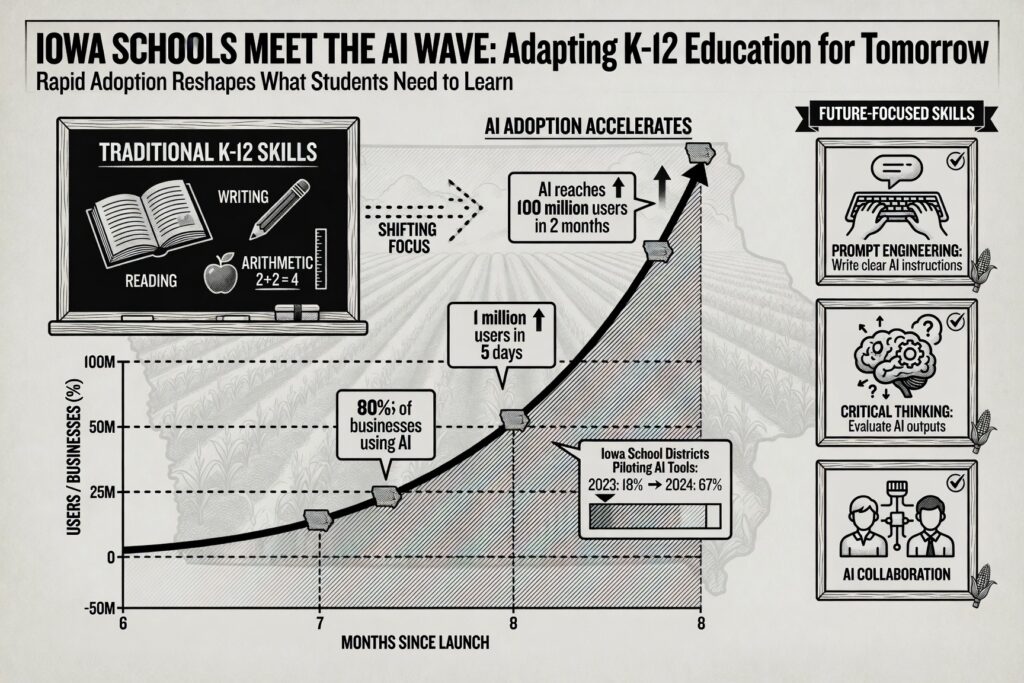
The rapid advance of AI is no longer a distant prospect — it demands immediate action from every education leader and policymaker in Iowa. Few developments in modern history will reshape the international playing field as profoundly or as quickly. Nations and school systems that fully embrace AI will gain a decisive edge. Those that hesitate risk falling behind. We no longer have the luxury of gradual, incremental change.
Within the next one to two years, AI voice and multimodal systems are expected to become so capable that the majority of everyday learning, problem-solving, and communication will occur through natural conversation, images, and video. When that shift happens, many of the skills we currently treat as the bedrock of K-12 education — prolonged emphasis on long-form reading, writing, and advanced mathematics — will become far less essential for the vast majority of students. Continuing to allocate years of classroom time and teacher training to these skills at current intensity levels risks becoming counterproductive.
Acknowledging the Pushback
This perspective will face strong resistance, and some of it is understandable. Many educators and parents will argue that reducing emphasis on reading, writing, and math will make students less capable, that these subjects are fundamental to a well-rounded education, and that we cannot place so much trust in technology. These concerns deserve serious discussion. However, they are largely rooted in a world that is rapidly disappearing. Comfort with tradition must now be weighed against the urgent realities of global competition and the demonstrated speed of AI adoption.
The Speed of Change Demands Urgency
AI reached 100 million active users in just two months. It hit one million users in only five days. Today, more than 80% of businesses worldwide are already using AI in at least one function. This is not a slow evolution — it is an unprecedented acceleration. Our education system cannot remain in “wait-and-see” mode. It must move into active, deliberate transformation.
Rethinking How We Train Teachers
Currently, Iowa’s teacher preparation programs focus heavily on training new educators to deliver traditional reading, writing, and math instruction. If AI can perform many of these tasks at a high level within the next few years, we face a clear misalignment: we are investing years preparing teachers to teach skills that many students will rarely need to execute manually, while under-emphasizing the capabilities that will matter most.
We must begin retraining and reorienting our teacher workforce now. The new priority should be preparing educators to teach students how to think clearly, ask precise and powerful questions, direct AI tools effectively, and critically evaluate the outputs they receive. Basic literacy and numeracy will still matter, but mastery-level instruction in these areas should be scaled back for most students in favor of higher-order skills.
Rethinking What We Teach in the Classroom
Across Iowa classrooms today, teachers are grappling with students using AI to complete assignments. Much of the discussion centers on preventing “cheating.” We are asking the wrong question.
Instead of fighting AI, we should redesign assignments around it. Rather than requiring students to write long research papers on their own, we should teach them how to use AI as a powerful collaborator — formulating strong prompts, guiding research, synthesizing information, and rigorously evaluating results. These are the exact skills they will need in the workforce and in life.
A Practical Path Forward for Iowa
To stay ahead, Iowa should establish a centralized AI Education Hub that connects in real time with every school district. This hub would ensure equitable access to the best tools for administrators, teachers, and students, deliver continuous curriculum guidance, and provide rapid feedback for both individual learning and system-wide improvement.
The stakes are high. If our education system fails to adapt at the speed of this technology, it risks becoming increasingly irrelevant to students, to industry, and to the economic future of our state. Industry is already moving. Students are already using these tools. The only question is whether our schools and policymakers will lead — or be left behind.
Iowa has the opportunity to become a national leader in preparing students for an AI-driven world. That leadership must begin now.
References: https://www.visualcapitalist.com/sp/taa02-charted-ai-adoption/